Join The Passion!

Join The Passion!

M-Station - Perfect Gift for Soccer Players

Showing posts with label goalkeeper. Show all posts

Tuesday, May 1, 2018

#1 Way To Improve Technique


The #1 ELEMENT your players need to find to guarantee better performance is... SPACE.


 Space. All great players find it, exploit it and benefit from doing so.


 “As an eventual receiver of the ball, you have to look in the open space for a position enabling you to get the football in good conditions. ... It is often a matter of one step more or less.” – Johan Cruyff


We speak of space being time and time being gold. It is that valuable. Gold. And it can be cashed in to accomplish remarkable results on the pitch. A player with space has time and that time affords a more effective technical execution. It may be less than a meter or it may be three. All space that can be exploited to your benefit against an opponent is worth seeking.


It may seem counter intuitive, but if you teach players to play with a deeper understanding of space, they will execute better. The parents on the sidelines and the casual onlooker will think that Johnny or Jane has become so much better technically. Wow, a completed pass. A probing shot. A purposeful dribble.


OK, maybe not the parents who yell “BOOT IT!” but we cannot win over everyone. The most important beneficiary of the productive management of space will be your player. She will dance within that space with confidence. She will find solutions with a fraction more time afforded to her.  Your player will not only appear technically better, but also become technically better as she seeks more technical quivers to add to her arsenal of skills. Demand will drive supply.


Ball control void of spatial awareness is of little service to a true footballer.


The greatest masters of the game were masters of so many components of the game. They could pass,
receive, shoot, dribble, and head the ball. But so many players worldwide can do that. Di Stefano, Pele, Cruyff, and Maradona were artists that delivered a solution when needed most.


“There’s only one moment in which you can arrive in time.  If you’re not there, you’re either too early or too late.”  - Johan Cruyff


In the end we must be honest with our children by explaining that there are no shortcuts to success within or beyond football.  And to refute my entire article here we should not reduce the beautiful game to guarantees and false promises.

But we can suggest that football is a multi-directional game, a choreographed dance in time and space to be enjoyed thoroughly with best friends, caring coaches and loving parents.  And we can go out to train it and to play it as such.


“The ideal space must contain elements of magic, serenity, sorcery, and mystery.” – Luis Barragan


Thursday, April 26, 2018

The Right Mindset in Soccer


After all your training is complete, your mindset is everything when it comes to performing consistently in soccer.

Your mindset is the difference between winning and losing.

Your mindset separates average play and next level-performance.

The biggest area affected by your mindset is the way you respond to adversity.

An avoidance mindset focuses on avoiding problems rather than focusing on solutions.

When your mind is focused on problems, more problems ensue such as:


--Anxiety
--Intense negative emotions
--Lower confidence
--Loss of focus
--Uncharacteristic mistakes

A negative mindset can be summed up by the statement, "Whatever happened to me?"

A positive mindset can be summed up by the phrase, "Whatever it takes!"

A positive mindset focuses on solutions, therefore, your confidence stays intact and you maintain an even keel emotionally.

A positive mindset centers around, "What can I do?" Rather than, "What can’t I do?" or, "What haven’t I done?"

Every moment is big in the a game. Moments can change games, moments can create a run. So I think that’s on all our minds. If there’s a loose ball, dive on the floor. If you can take a charge, do that. Whatever it takes.

The "whatever it takes" mindset helps the team fight through a highly contested match up against the stronger opponents.

Which type of athlete are you?

Are you the type of athlete who is dragged down by thoughts such as, "What has happened to me?"

Or the athlete who has the mindset, "What can I make happen?"

The reality is that your mi
ndset is a choice.

If you want to have a "whatever it takes" mentality, then you need to consciously make the choice to foster those types of positive thoughts.

You need to let go of what has happened and, instead, make things happen.  

A positive mindset will not happen automatically.

You need to choose the mindset that enables you to perform at your peak, then, act accordingly.

How to Develop a Positive "Whatever it Takes" Mindset:

Choose a motto for yourself that will highlight a positive mindset...

How do you want to compete under the big lights? How do you want to play when your game is off? How do you want to play against tough competition?

Consider this motto as your personal slogan similar to Nike’s, "Just do it”.

Frequently recite your personal slogan to yourself to keep you focused on what you want to make happen.


Tuesday, February 6, 2018

Need 3 FEMALE PLAYERS for Top League in Portugal


ViaSoccer, LLC. is an extension of Victory Soccer Club that provides representation services for players willing to play professionally in Portugal and other leagues.

-------------------------------------------------------------------------------------------

We are looking for 3 FEMALE PLAYERS to join a Portuguese club at the Top League in the next season 2018/19.

August starts preseason and it goes till June of 2019 with a Winter Break. We need a Goalkeeper, a midfielder and a forward.

Players must have a highlights video and over 20 years old with American Passport.

Club offers housing, food and salary to be negotiated upon experience.

Contact Coach Sergio Taborda at

 phone:202.253.6166  or  email: sergiotaborda@victorysoccerclub.com

Thursday, July 13, 2017

Endurance Matters

In youth athletics, endurance matters.

The team with the most energy towards the end of a game usually wins.

Lots of youth athletes look AMAZING in the first half of a game, and then things start to fall apart after half time.

They get tired.

And tired teams usually don’t play their best.

If you want to ensure your team comes out fresh in the second half, you need to start doing HIIT.


HIIT= High Intensity Interval Training

High-Intensity Interval Training describes any workout that alternates between intense bursts of activity and fixed periods of less-intense activity.


It’s Efficient: In fact, our HIIT circuits take just 10 minutes, but your athletes will achieve MORE in 10 minutes than they would running for half an hour.

It Improves Cardio Like Nothing Else: Most youth athletes aren’t used to pushing into the anaerobic zone (where it’s actually hard to get out a sentence because you are breathing so hard).   But it’s that anaerobic zone that offers amazing results.  One 2006 study found that after 8 weeks of doing HIIT workouts, subjects could bicycle twice as long as they could before the study, while maintaining the same pace.


It’s Fun: There are lots of exercises you can use for a HIIT circuit, but we’ve designed ours to be fun for kids. All of our HIIT exercises involve a ball.


Get Ready for the Season: Sign up NOW!!!


Thursday, June 1, 2017

Change Your Game in Soccer

Your greatest weapon when playing soccer is your mind prior to and during the game.

Your mindset is how you mentally approach and prepare for soccer.

When you have an effective mindset, you have belief that you can win games, or at least compete at a high level even against very good teams.

Negative thoughts will creep in for you, but the goal is to have most of your thoughts enhance confidence and have the ability to refocus when negativity creeps in.

A positive mindset reduces anxiety prior to games, allows you to play freely or intuitively on the pitch and keeps the focus on the task at hand.

A positive mindset not only affects how you approach games, but also how you approach practices and training sessions.

When you have intensity and drive, you train hard and compete in practice rather than merely being physically present in practice.

When you have a strong mindset, you are passionate about competition and enjoy playing your sport, both of which contribute to your success as an athlete.

Is your mindset helpful or hurt your game?

If your mindset is mostly negative, do you think you can do anything about it? Or do you believe "it is what it is?"

The truth is your mindset is a choice. YOU control your mindset.

Your mindset is something you foster by your decision of where to place your focus.

Focus on fear, deficiencies in your game, mistakes, comparisons or the negative criticisms of other, you will grow a negative mindset... and that negative mindset will show in your performance during games.

Focus on your strengths, effort in training, successes and your will to improve your game, and you will cultivate a positive mindset.

A positive mindset will produce positive results in games. Positive results don’t always mean wins; it means playing aggressively, playing to your potential, competing throughout the game, never giving up and making plays.


Change your mindset... change your game!

Tips For Fostering a Positive Competitive Mindset:

"Competitive" means to compete or to make a full-out effort to be successful.

You can improve your mindset by getting into the habit of competing at your peak all the time.  Start competing in practice... push during drills, race to the ball, play aggressively during scrimmages, etc.


As you start winning battles, finishing first during runs, hustling in games, you will notice that your mindset changes... and the results will be positive!


Tuesday, May 9, 2017

Invisible Training

Not all performance improvements are gained in the field


Have you ever stopped to think about when improvement occurs in your training cycle? You may have never thought about this, but you should. Is it right after a hard workout? Is it 12 or 24 hours after a workout?

For most people, the benefits of the work done need time to transpire, and once the body has adapted, you start to see performance improvements.

Some coaches even refer to this recovery period as “invisible training,” less obvious than the actual workout, but vitally important. You may not be doing sets and reps, but when and how you recover determines how much you’ll reap from your “real training” sessions.

Understanding when your improvement happens is crucial if you want to continue to improve your performance because the ability to recover is what changes most as you age. You do not lose the ability to increase strength or power as you age, rather your body slows down its recovery response rate. This cannot be overstated: your ability to recover from training is what changes as you age, not your ability to improve strength or power.

If you don’t adapt your training schedule and intensity to match the biological changes that your body is going through, your training will not continue to produce the effects you seek.


Anyone can train hard, that’s usually not the issue. Instead, it’s whether or not you know when to train hard and when to back off to allow your body to fully recover. If you don’t know when to retreat, you’ll slowly drive yourself into a deeper and deeper hole. This is when sickness and sub-par performances take the place of feeling healthy and seeing improvements on a regular basis. Also known as over-training, this is a lousy place for performance-focused players to reside, and it happens to many Top players who may think that more training is always better.

Though this problem is common, the fix is simple. Shift your mindset. Realize that some benefits are gained not from training harder, but by recovering better. Intensify your recovery period, and you’ll notice more gains. This might seem counter intuitive, but recovering effectively and consistently is a skill you can learn, and you’ll probably have to experiment to find the best methods for your body.
Over the years, some of the athletes I train have found one or two strategies from this list that really help. Individual variation is an important component of applying these strategies. Experiment with these strategies to see whether your performance improves.


Recovery Strategies

Consistent and sufficient sleep. Many people are chronically sleep deprived, and although it can be difficult to get enough sleep, it’s vitally important to your performance not just in the field, but across all aspects of your life.

Proper nutrition. We all seem to be eating on the run these days, but take the time to eat properly and you’ll likely see a performance increase when your body has the appropriate balance of nutrients it needs to perform at the top level.

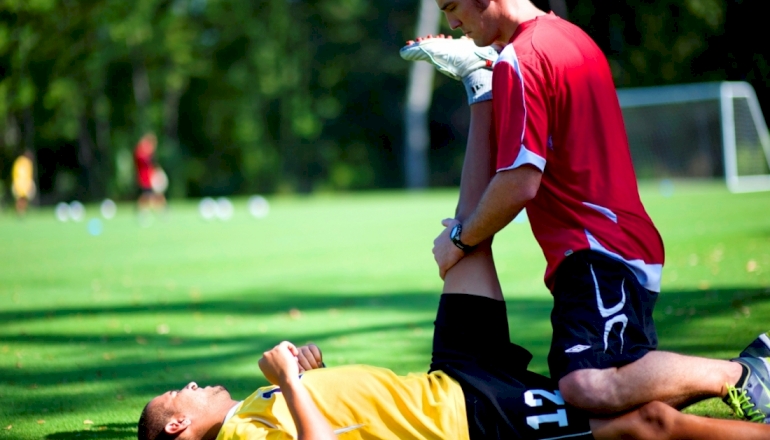
Stretching, foam rolling. All of these activities can help release lactic acid that accumulates in the muscles during a training session. When the body can efficiently flush these toxins out and repair the training-inflicted damage done to the muscles during a workout, you will likely see bigger gains from your work in the field.

Proper warm-up and cool-down procedures. Similar to stretching, warming up and cooling down before and after a tough training session prepares your body appropriately for the work that’s coming and helps the body process the work after it’s been completed.

Icing, cold plunges, and contrast baths. Though chilly, these methods can help reduce inflammation in the body after a workout, which also helps flush out toxins and improves your body’s response to a training session.

Massage and chiropractic adjustments. Keeping everything limber and in alignment can also help your body work smoothly and may enable you to get more out of your training time.


Remember, improvement does not come strictly from actual training sessions. You improve during your recovery, that space in between training sessions when your body does important repair, adaption, and improvement functions.


Thursday, March 9, 2017

Victory Soccer Club Receives 2017 Best of Business Award


Beverly Award Program Honors the Achievement

Victory Soccer Club has been selected three years in a row for the 2017 Best of Beverly Awards for Soccer Clubs and now qualifies for the Beverly Business Hall of Fame.

BEVERLY March 2, 2017 -- Victory Soccer Club has been selected for the 2017 Best of Beverly

Award in the Soccer Clubs category by the Beverly Award Program.

Each year, the Beverly Award Program identifies companies that we believe have achieved exceptional marketing success in their local community and business category. These are local companies that enhance the positive image of small business through service to their customers and our community. These exceptional companies help make the Beverly area a great place to live, work and play.

Various sources of information were gathered and analyzed to choose the winners in each category. The 2017 Beverly Award Program focuses on quality, not quantity. Winners are determined based on the information gathered both internally by the Beverly Award Program and data provided by third parties.

About Beverly Award Program

The Beverly Award Program is an annual awards program honoring the achievements and accomplishments of local businesses throughout the Beverly area. Recognition is given to those companies that have shown the ability to use their best practices and implemented programs to generate competitive advantages and long-term value.

The Beverly Award Program was established to recognize the best of local businesses in our community. Our organization works exclusively with local business owners, trade groups, professional associations and other business advertising and marketing groups. Our mission is to recognize the small business community's contributions to the U.S. economy.


SOURCE: Beverly Award Program

CONTACT:
Beverly Award Program
Email: PublicRelations@onlineawarded.org


Thursday, February 16, 2017

Feel Intimidated?!?

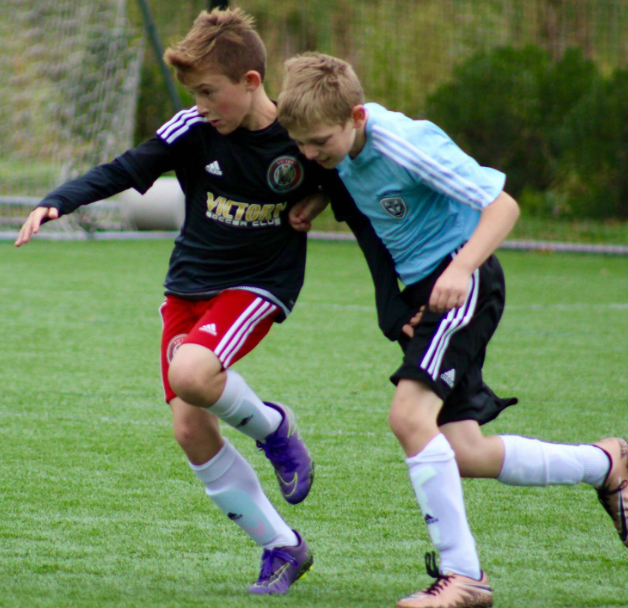
Playing a soccer game against a more physical team can be intimidating for some players.

A team with highly aggressive or bigger players can take the focus off your soccer game if you allow. Soon, you will start to worry about getting fouled, injured or being physically dominated for 90 minutes.

You may even enter the match with a predetermined outcome, "We are going to get crushed because they are bullies on the field."

When you allow the opposing team to steal your focus, you are doomed.

One soccer player I work with would be a shell of himself when playing physical teams.

This player was an undersized but talented finesse player.

During most games, he could weave through traffic, thread the needle on passes and score with regularity.

Unfortunately, when he played against teams with a physical reputation, he would play with trepidation, avoid contact and force passes just to get rid of the ball quickly. He would get so anxious watching his opponents warm-up and fear would course through his veins.

Even though he was skilled enough to outplay these rough opponents, he would freeze during the game and lose his confidence.

He desperately wanted to find a way to overcome this problem so he could play the way he knew he could.

Intimidation can affect even the best teams in the world.

Intimidation has nothing to do with your opponent’s size/strength and everything to do with your mentality. 

Intimidation requires consent, meaning you allow the other team to dictate how you think, feel and play. When your opponents have your focus, the game is practically a foregone conclusion.

Competing against physically aggressive teams requires both physical training and mental toughness.

It's important to prepare for all types of opponents and different types of circumstances so you are confident you can handle whatever situation occurs during a game. 

When playing rough opponents, you may need to alter your game plan but you must stay focused on that game plan and play accordingly.

When the opposing team cannot get in your head, they will start to play recklessly giving you the mental edge.

Tips for Playing Mentally Tough Against Rough Teams

First, know that many physically rough teams are looking to get you frustrated and scared to engage.

Intimidation occurs when you accept that you are intimidated and play scared. 

When you focus on the other team's tactics, remind yourself of your skill set or game plan.

Focus on your speed, agility, quickness, and other talents to counter the opponent.


Dr. Patrick Cohn

Peak Performance Sports, LLC
Mental Training for a Competitive Edge


Thursday, October 27, 2016

How to Mentally Prepare for Games - Alex Morgan Way

Many coaches think their team will perform well if they can get all athletes hyped up before competition.

Thus coaches use pep talks, team cheers, and loud ‘pump up’ music as a means to get athletes psyched up for competition.

Unfortunately, these ‘get psyched’ techniques do not work for every athlete. Every athlete is different when you talk about optimal pregame intensity.
If you have athletes that are more anxious, psych up strategies move these athletes into an over-anxious state.

Anxious athletes may take several minutes to settle into their game, and for some of these athletes, they never seem to come down from that nervous feeling for the duration of the game.
To make matters worse, the more important the game, the more revved up these athletes become, which usually leads to tight play and early mistakes.

As an athlete, you want to be in an optimal zone of intensity prior to competition, that is you need to move into a zone where you are mentally prepared, emotionally ready and properly focused for the start of a game.

If you are more of a nervous or anxious type athlete, you would be better served to learn how to calm down prior to a competition.


US Women’s National Soccer Team forward, Alex Morgan, understands the importance of getting her mind right before the start of a game.

MORGAN: "A lot of people think [soccer] is physically taxing on our bodies, but it's actually just as taxing mentally."

Part of Morgan’s pregame routine is to move into a state of calmness which she credits for her successful level of play in the biggest soccer tournaments, such as the 2012 London Olympics, the 2015 World Cup and the 2016 Rio Olympics.

MORGAN: "I never get too hyped up too early before a game—I feel like that leads to having restless legs and mind. I do a lot of mental visualization and use breathing techniques just to kind of calm myself down before a game."

When your heart is pounding, your thoughts are racing, your focus is pulled into a thousand directions and you become overwhelmed with anxiety, it's impossible to play at your peak.

Therefore, you might benefit from learning how to relax your mind and body prior to competition so you can be mentally ready to perform well when the whistle blows.


Many players use the following techniques to calm themselves down prior to a game:

1. Deep breathing – Taking several deep slow breaths for a period of time will slow down your respiration and heart rate and provide you with a sense of calmness.

2. Imagery – Visualizing yourself in a calm surrounding, like the beach, can be a soothing escape before a game.

3. Listening to music – Slow tempo music will have the effect of slowing down your heart rate and distract your mind from thinking about the game too early before its start.

4. Relaxation or massage – these techniques serve to relax your muscles and body before game time.


Tips for Pregame Calmness:

First, know what works best for you–do you need get pumped up or calm down before competition?
Choose a strategy that works for you. While meditation may benefit some, other athletes may not find that technique too relaxing.

For example, some players I worked with complained that they were too relaxed at the start of the game after doing visualization before the game!

Practice your relaxation technique. You need to become proficient at any technique for it to work in your favor.

Managing your fear is also key to helping your control your emotions before a game.

A relaxed mind and body optimally prepare you to play your best from the very first minute of a game!


Saturday, October 22, 2016

The Goalkeeper Pressure

The goalkeeper position probably is the position that coaches demand perfection since any small mistake can lead to a goal. Is not a valued position or well recognized in majority of the cases but the goalkeeper position is of extreme importance if not the most important.

The goalkeeper can be the hero or villain in a game since he will be present in that most expected moment of the game that is deny the goal or allow it... But the pressure in the goalkeeper role it goes behind in just making saves. Is expected from the keeper to be cool, courageous, brave and sometimes a bit of craziness is expected.

We ask them to be communicative, a leader of defense and team but also that remain calm in handling moments of pressure during the game. Is important that the keeper be focus and efficient 100% of the time, make good decisions and maintain good positioning throughout the game.


The keeper needs to be excellent in 1v1 situations and hopes are that can save the team from a situation where probably the opponent will score. We ask to be good playing with the feet also to take goal kicks, to play short or long and to work as a sweeper in case of long balls... and we expect precision... Basically, we expect everything from our keeper.

But this is not the biggest pressure of a keeper. This is the life chosen, their mission... to be part of the teams success.

The problem is when this demands are not followed by regular specialized training. The problem is when the feedback only comes when the keeper makes a mistake. The problem is when we don't praise the efficiency of the keeper the same way we critic the mistakes.

The problem is when the demands are totally not adjusted to the age of a keeper and his/her technical level.

Maybe some coaches never thought about it but can you imagine an 8/9 year old taking goal kicks with 13 players in front of them and so many voices telling what to do and a referee telling to hurry up?

Well, that is pressure...

Most of this young keepers are not even there because they chose to... and they fear to fail and let the team down...


As a former professional keeper I experienced many failures and many successes. I was the best in one week just to be a disappointment in the next... The newspaper needs heroes and villains to make headlines.

Life is made of decisions and the goalkeeper life is no different with decisions needed to be made constantly where the success of the team depends on it.

When I dressed my team jersey and put on those gloves I felt special... I knew of the pressure on my shoulders but the passion I had for the game was superior than any pressure or disappointment.

Failing or succeeding I knew I always would put those gloves on again...


Friday, September 30, 2016

Creating decision makers

So if we are playing a 3v3 game where the task is that we want the young players to identify and attack free space, I ask them what information should the young player be seeking out and what invitations are being sent or communicated to him/her by opponents and teammates actions?
A key challenge for coaches is to design training and create learning environments that result in sustainable motivation. Recent research in coaching is highlighting the importance of players experiencing and developing game understanding (technically, tactically, mentally and physically). This is best applied by learning to play via learning environments that contain the key information sources present in performance or match environments. This will of course have technical and pedagogical implications. By moving from an instruction led approach to a more enabling and supporting role we can meet and support the skill acquisition and basic psychological needs that underpin a nonlinear pedagogy and self-determined motivation. Adopting such an approach is not easy; perhaps not as easy as setting up static drills where little game knowledge is required by coaches. To design effective learning environments using this approach, the coach must
  1. Have a good knowledge of the sport
  2. Have a good understanding of learners and the learning process
  3. Always take in to consideration that growth and development happens in direct contact with people (individuals) and takes place in a variety of different situations
  4. Design training where decision-making is returned to the performer (The traditional passing drill A to B, B to C, C to A does not achieve this)
  5. Understand that learning is not a linear process and that there will sometimes be periods of steady or sudden improvements as well as periods of regression.
The challenge for the coach is to design individual learning environments that ultimately lead to highly skilled technicians with highly developed game intelligence. It is proposed that this can be achieved by following the key principles of non-linear pedagogy, one of which is representative learning design.

Representative Learning Design
For the purpose of retention and transfer, training should be representative of the performance environment. It should be designed to contain key information sources that are necessary for the learner to become attuned to the appropriate affordance for action, that is ‘football action’ (pressing, dribbling, shooting). Affordances are about action they are invitations, possibilities for ‘football action’ in the environment. If they are to be perceived there must be information about them.
To understand ‘football action’ one must understand the big picture. A picture that dictates that no action is isolated but is nested in interactions between team mates and opponents both within the game and from previous games.

Every Football Action Involves a Decision
Every technique is functional, situation- dependent, infinitely variable and highly individual. As a consequence, isolated physical training that only focuses on specific aspects of fitness is limited in terms of developing football specific aspects of fitness. For example, how a player sprints during an isolated running drill and how that player sprints when performing the football action of pressing are not the same! Isolated strategic (11 v 0) and isolated tactical drills lack inter-individual communication of essential information. For example, the movements of team mates and opponents provides information that drives our own movements but also players require them to communicate and share information with each other verbally or with hand gestures.
For example, consider the options for an attacker when two defenders are converging and closing the gap between them. What are the possible affordances offered to the player in possession?
  1. The player can dribble the ball between the two defenders
  2. The player can pass the ball in depth between the two players to an oncoming or dropping forward
These are just two of the affordances offered. The information has been communicated and now a decision must be made and carried out using a ‘football action’. What determines the choice of a ‘football action’ by the player in possession is that player’s ‘effectivities’, or put another way, his or her capabilities to act on the possibilities invited by the dynamic affordance in the environment.
A fast or explosive player may see this as a possibility to dribble the ball though the gap between the two converging defenders. A slower player may know he or she lacks sufficient pace to exploit the narrowing space and pick up on the affordance to pass the ball through the gap to an oncoming or dropping forward.
How the player is perceiving and acting is very important here. Often referred to in the research literature as the role of ‘agency’. Players can choose to accept or reject invitations provided by affordances. In a dynamic sport like football it may be necessary to delay or to even stop an invitation that you have begun to address, and perceive how through another action you can change it towards another path.
The player in example 1 above may delay his action by slowing down for a split second. This was a ‘football action’ typical of the great Johan Cruyff. As soon as the approaching defenders would respond to him by also slowing down Cruyff would suddenly explode in to action. The use of creativity, deception and disguise to generate uncertainty in their opponents are all traits of top professional footballers.


The player in example number 2 may have perceived the information and decided to play a penetrating pass between the two defenders to an oncoming forward. However, due to a problem in communication the forward may have timed their run incorrectly and ran in to an offside position. Thus, the emergence of new information for the player in possession to perceive and a new path with a new decision to be carried out. A second oncoming attacker may have been perceived by the player in possession (think Pirlo) who plays a pass between the two defenders. The oncoming attacker receives the ball and attacks the space in front towards goal. The ‘offside player’ is now onside and may well provide an extra passing option for the attacker in possession. Here we are entering the realm of “the perception of shared affordances (for others and of others) as the main communication channel between team members”. 
Representative learning design is essential to develop understanding of team mates action capabilities and of course opponents. Only then can we see the through ball into the space of an oncoming forward. The weight and direction of the pass is therefore informed by the knowledge of how quick the team mate is.
Design
We promote the influence of context. The use of game forms in training sessions that ‘directly talk to the players’. Attacker, defender actions are co-adaptive. Using the principles of co-adaptability (One individual evolves the capacity to behave in a certain way. The other individual then has to adapt to that so there is a co- adaptation process going on). Through effective game design, the coach can try and “nudge” the young learners into constantly trying to adapt new ways to counteract new strategies that opponents are introducing in to the game.
Manipulation of time and space task constraints to facilitate change in the perception action coupling
Training sessions should offer affordances – possibilities for action, choice, challenge and variability to the players/learners to learn and to re-learn.

The Use of Questioning and Context in Creating a Motivational Climate
Questions are a useful tool in generating feelings of involvement, relatedness and the promotion of self- determination behaviors. Questions in learning environments, that contain the key information sources present in performance or match environments can be a powerful tool. Questions can be directed at both groups and individuals and should be formulated to open the learner up to new perspectives or information to guide their perception and action.
Football is a game of constant decision making based on communication/information. Every training session should have as many aspects of football as possible. The aspects used should interact and should also influence each other.

Creating competitive stress

The best decision-makers in sport adapt their decisions and actions to a changing environment, and perform in unstable or uncertain situations. Coaches need to emphasize adaptability and variability in training, rather than the traditional approach that focuses mainly on repetition and stability of athlete decisions and actions.


Friday, September 18, 2015

ADVICE FOR PLAYERS: HONORING YOUR COMMITMENT

Champions are champions, not because they are necessarily the most physically able or the most physically talented. Champions are champions because they honor their commitment. When they set out to do something they do it, without fail, without trepidation, without question, with certainty. That is why they are champions.

Commitment is imperative to become the very best soccer player you can be. It’s a vital mental quality on and off the pitch. While competing a soccer player needs to commit to their tackles, to their awareness and to their movement. They need to commit to the tactical plan laid out for them and need to commit to supporting their team mates as the game progresses. Away from the pressure of game play, a soccer player must commit to their training.


Commitment – Set Goals

A champion carries certainty into every training session by having a defined set of goals to accomplish. These goals relate to the technical, tactical, mental and physical sides of the game. They are related to weaknesses that a player wants to improve and strengths a player wants to magnify. A champion is committed to improving. Committed to developing their soccer and committed to being a student of their game and the game. They don’t wait around for one of their coaches to set stretch goals. They break their game down into categories and arrive at training with a list of three or four areas that they want to work on. They take ownership. That is the commitment in training they need.

Commitment – Self Talk

A committed soccer player has the inner voice of a champion – “Keep working, keep moving, keep playing, stay focused, on my toes, sharp, sharp, sharp”. They use their self-talk as a motivator, an instructor, an emotional leveller and a focus shifter. They talk to themselves. They don’t listen to themselves. They don’t listen to the voice that says “wait”. Wait isn’t a thought they pay attention to when it comes to the things they have to execute to improve their game. They don’t listen to themselves, they talk to themselves. They talk to “wait”. They talk firmly and loudly.
“There is no wait, there is only do.” With those words they take action. They continue the sets in the gym. They eat like a champion. Sleep like a champion. Trains like a champion. They carries on playing when they’ve made a mistake or goes a goal down. They use their self-talk as an inner compass and an inner driver to keep on going.
“Come on, one more set. Come on, keep focused. Come on, stay strong. Come on, forget that. Come on, focus on your own game. Come on, work harder.”


Commitment – Match Analysis

A champion commits to a post game appraisal no matter the result. If they lost they don’t get too down – they just think about what needs to go better next time. If they won, they don’t get too up – just thinks about what they need to repeat in the next game. They love reflecting with objectivity. To do this, they ask. They take the time to ask others about what they saw – the good and the bad. Asks the coaches and their parents, friends and family. Of course they have a BS filter. They are not going to attend to everything everyone says, but things that make sense to them and things they recognise as perenial weaknesses, they attend to.


Commitment – Always

A lack of commitment can rear its ugly head on a day-to-day basis. It’s that voice inside of you that says “shortcut”. It’s that voice inside of you that says “It doesn’t matter”. But it does matter. In soccer everything matters. From the critical essentials of training and playing to the less than obvious and on so subtle work on your mentality and mindset.
A lack of commitment can come packaged as a feeling as well as a thought. That feeling reverberates around your body causing you to eat badly, shirk the gym, avoid the extras, ignore the analysis. That’s what a lack of commitment does. And it eats away at your ability. It diminishes your potential.

With every hour you lack commitment so your future self looks different. So your future rewards look different. So your future success looks different. So your future joy looks different. So the amount of games you play adds up differently. So your reputation looks different.

Put commitment at the forefront of your game. 1,000 keepie uppies means nothing if you can’t and don’t honor your commitment for every facet of the game. Only then will you really know just how good you can be.


GoalNation’s columnist Dan Abrahams shares his insights and advice for success on the soccer field for players of all ages. A global sport psychologist and author specializing in soccer, Abrahams is based in England and works with professional soccer players in the English Premier League (EPL).


http://6e560yxjhx6wal30vchi1bh2sq.hop.clickbank.net/

Monday, June 15, 2015

Off Season Training


“The more you sweat in times of peace, the less you bleed in times of war,” is a saying that is certainly full of wisdom. Off-season training is one area where athletes can get a tremendous bang for their buck. This article aims to provide wisdom, based on knowledge and experience, for training in the off-season.

Before we get into specifics, we have to define what the off-season actually is. The off-season is a period of time when an athlete is not participating competitively in their sport. Team sports like soccer, basketball, and baseball have a clearly defined off-season. Seasons in other sports such as tennis are not as easily defined. And with the oftentimes overly demanding schedules of many youth sports teams, many young athletes jump from travel to all-star and then varsity high school teams hoping to get ahead, never leaving any time for an actual off-season. 


It is critical for all athletes, professional to youth, to have some sort of off-season built into the year. Playing sports at competitive maximums is taxing on the human body.

 If you cannot play your sport in the off-season, then what can you do? First, I am not going to tell you that you cannot play your sport in the off-season. What I will tell you is that you should not be competing in your sport in the off-season. In fact, competing in your sport is the definition of being in-season. This downtime is an opportunity to perform technical skill work or practice but at a much lower intensity and volume than during your competitive season. For example, this would be the time a soccer player could improve dribbling skills or other technical work. The key takeaway here is you are not playing your sport at competitive max or “racing speed.”

So what should the training be like when an athlete is not in season? Off-season training for youth athletes should focus on improving foundational movement patterns and general strength and conditioning. In fact, this should be the bulk of the work done in the off-season. This work helps establish a base for the future. Improving fundamental movement patterns like jumping, landing, decelerating, squatting, hinging at the hip, pushing, and pulling all improve overall athleticism. The conditioning work done to the aerobic system in the off-season provides the base for the higher-intensity demands to come in the pre-season and competitive seasons. The improvement of general strength creates the potential to sprint faster, jump higher, and throw harder during the competitive season. You simply cannot build these qualities in the middle of a competitive season. Instead, you must build these qualities in the off-season so they can be expressed during the competitive season.


 Each sport and athlete has specific needs, and if you are serious about getting the most out of the off-season time, I would hire a knowledgeable and experienced trainer. But the bottom line is to do your homework and find someone who thinks long-term and has your best interest in mind. With that being said, in a typical 4-12 week off-season, three of the most common goals are to develop the aerobic energy system, improve general strength, and clean up movement patterns.

Regardless of the sport, a well-conditioned aerobic system is essential. Obviously, a well-conditioned aerobic system will benefit someone like a distance runner or soccer player. However, what most people do not understand is that a fine-tuned aerobic system provides benefits in almost all sports.

This is because the aerobic system (energy with oxygen) is responsible for replenishing the fuel for the anaerobic energy system (energy without oxygen). In other words, football and tennis players need their aerobic system to replenish the anaerobic systems that allow them to perform bursts of high-intensity work intervals. This is a tremendous advantage late in the game during the competitive season, and it can only be accomplished by doing some work dedicated to improving the ability of the cardiovascular system to deliver oxygen to working muscle. Although training for peak aerobic performance has been shown to compromise anaerobic performance in elite athletes, this potential drawback is not typically significant enough to be of concern to a young athlete who has far more to gain in terms of positive body composition and overall fitness levels.


 Another benefit of aerobic training in the off-season is that it promotes recovery. Delivering oxygen-rich blood throughout the body aids in rebuilding tissues that take a beating during the competitive season. In addition, it is relatively easy on the nervous system. The nervous system is typically taxed heavily during the competitive season with all the quick movements and maximal muscle contractions. Conversely, aerobic training is characterized by sustained or repeated submaximal efforts, providing low-level neurological stimulation. Examples of aerobic training include long runs, swimming, or biking at a heart rate of 130-150 beats per minute.


Off-season training for youth athletes should also have an emphasis on lifting heavy things and putting on some muscle mass. The force a muscle is able to produce is directly related to its cross-sectional area. If you want to be able to run, jump, and throw harder next season, strength training is essential. Strength training simply means you are going to stress the muscle by lifting something heavy, and your body will respond by making it bigger and stronger. An athlete does not have to go to the weight room or have access to fancy equipment to strength train. In fact, for most youth athletes, body weight is the best place to start. After all, if you cannot move your own body weight appropriately, adding 50 pounds on top of your back is asking for an injury.


 When strength training, the focus should be on movement patterns rather than on specific muscles. For example, you want to improve strength in fundamental movement patterns such as squatting, hip hinging, pushing, pulling, and core stability. This is easily done with body weight, free weights, sandbags, and resistance bands. It is not easily done with the machines you find in most gyms that isolate specific muscles and joints.

Building a solid foundation of strength in the off-season is followed by learning how to express that newly developed strength during the pre-season and fully expressing the strength in the competitive season. The key here is to focus on improving general strength in the off-season and then working during the pre-season and competitive season to apply it.

The final objective of the off-season is to clean up movement patterns. This is the time to make sure you can absorb force correctly, clean up fundamental patterns, and develop good posture. This aspect of training is becoming even more important in today’s society. Think about the amount of time children spend sitting on the computer, texting on their phone, and sitting in classrooms. It is causing an epidemic of bad posture and inefficient movement in those compromised positions. Even worse, training and competing in them is a major contributing factor to several youth sports injuries such as spondylolysis (stress fracture in the lower back) and shoulder injuries. When you spend all day hunched over and your lower back is in excessive curvature, you develop poor posture, and this can set off any number of ailments when training load is increased.


The above pyramid of athletic development shows why movement patterns are so important to develop in an off-season training program. Clearly, movement is the base for all sports skills. You cannot layer fitness and sports skills on top of dysfunctional movement without eventually paying the price, and the off-season is the best time to develop those skills since time and effort playing sport are at a minimum.

It is impossible to prescribe an all-encompassing general workout for the off-season because the needs of each athlete and sport are unique. Some athletes may need to spend more time developing strength and others improving conditioning. However, below is a very general look at the typical week of training in the off-season. Planning training or periodization is a science in and of itself, but one of the biggest things to notice below is how the training is spaced out. An athlete cannot work hard 3 or 4 days in a row and then take 3 or 4 days off. Training is nothing more than applying stress to the body. The body then adapts to the stresses placed upon it. The real physical changes happen between rather than during workouts. Understanding the importance of rest and proper nutrition between workouts will maximize success and allow you to train both hard and smart.

Monday
Tuesday
Wednesday
Thursday
Friday
Saturday
Sunday
Dynamic Warm-Up
Aerobic Training
Dynamic Warm-Up
Strength Training (AM)
Sport-Specific or Agility Work (PM)
Dynamic Warm-Up
Aerobic Training
Dynamic Warm-Up
Strength Training (AM)
Sport-Specific or Agility Work (PM))
Dynamic Warm-Up
Aerobic Training
Dynamic Warm-Up
Strength Training (AM)
Sport-Specific or Agility Work (PM)
Off
Recovery & Regeneration


If you look at everything presented about off-season training and put it in the context of the bigger picture, it becomes clear how important it is when thinking long-term. If you understand that, then I will let you in on a little secret about developing champion athletes.

Most parents and coaches are only concerned with the short-term. They want to win the big game next week, win the tournament this weekend, or make the U-12 all-star soccer team. They may achieve those things, but they take shortcuts to get them, such as skipping the off-season. Those shortcuts eventually catch up.

On the other hand, the true champion athletes are focused on the long-term from the very beginning, and they never take shortcuts. They do the work in the off-season, and over the course of years, they develop outstanding conditioning and strength while often avoiding injury. They also are the ones who may have missed out on winning the championship in 7th grade, but they eventually end up with scholarship offers and notable accomplishments when it counts.

To conclude, I hope this article sheds some light on just how important off-season training really is to in-season performance. If you pay the price of time and sweat during the off-season training, you certainly will reap the benefits during the heat of the battle in-season.